What Is Web Development? Frontend, Backend and What Businesses Need
Discover what web development is, exploring frontend, backend, and how it drives business success. Learn essential types of website development today.
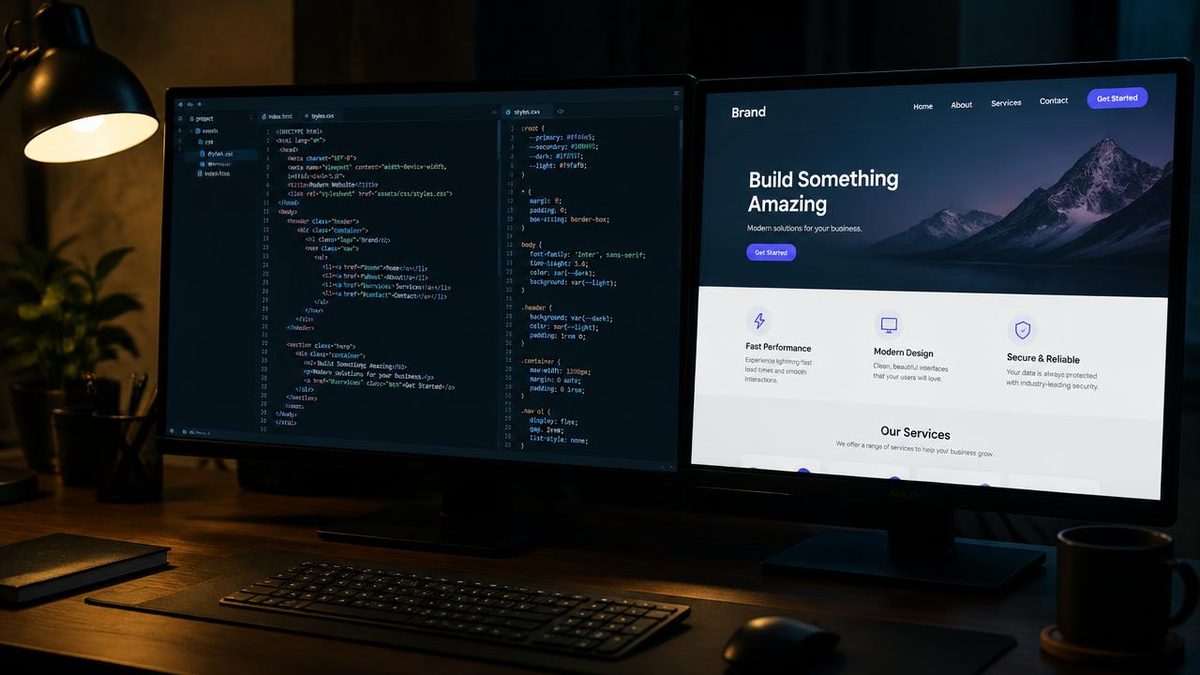
In today's digital-first world, your website is more than just an online brochure; it's your virtual storefront, your lead generation engine, and often the first impression a potential customer has of your brand. But what does it actually take to bring a website to life? The answer lies in the multifaceted discipline of web development. For business owners, understanding the basics is crucial for making informed decisions, allocating budgets effectively, and choosing the right technical partner.
So, what is web development? At its core, it is the work involved in building, creating, and maintaining websites and web applications. It encompasses everything from a simple, single static page of plain text to complex e-commerce platforms, social networks, or AI-powered tools. Led by our CEO Muhammad Zain, with over a dozen years of experience in technology and business, our team at ZK Solutions has navigated countless web development projects, and we're here to demystify the process for you.
What Is Web Development, Really?
Think of building a website like building a house. You need an architect to design the blueprint and an interior designer to make it beautiful and functional (web design). But you also need builders, electricians, and plumbers to construct the foundation, run the wiring, and make sure the water flows. That construction and utility work is web development. It's the technical craft of writing code that tells a web browser how to display a site's content and how to handle user interactions.
This process is a blend of creativity and logic. It's about solving problems to create a seamless user experience while ensuring the technology behind the scenes is robust, secure, and efficient. It's not a one-time event but an ongoing process that includes planning, coding, testing, launching, and continuous maintenance to keep the site secure and performing optimally.
The Two Core Pillars: Types of Web Development
Web development is primarily divided into two main categories: frontend and backend. A third category, full-stack, refers to a developer who is proficient in both. Understanding these distinctions is key to understanding what your project requires.
Frontend Development: The User's World
Frontend development, also known as client-side development, is everything a user sees and interacts with directly in their web browser. If web development is building a house, the frontend is the interior design, the paint colour, the placement of furniture, the light switches, and the door handles. It's all about the user experience (UX) and user interface (UI).
The primary goal of a frontend developer is to ensure the website is easy to navigate, visually appealing, and responsive (meaning it looks and works great on all devices, from desktops to tablets and mobile phones).
The core technologies used in frontend development are: - **HTML (HyperText Markup Language):** This provides the basic structure and content of the website—the skeleton. It defines headings, paragraphs, images, and other elements on a page. - **CSS (Cascading Style Sheets):** This is the styling language used to control the presentation, formatting, and layout. It dictates colours, fonts, spacing, and the overall visual look—the skin and clothes. - **JavaScript:** This is the programming language that adds interactivity and dynamic functionality. When you click a button, see a pop-up, or watch an animated element, you're seeing JavaScript at work—the muscles and nervous system.
A good frontend is intuitive. Visitors shouldn't have to think about how to find information or complete an action. It should just feel natural.
Backend Development: The Engine Room
Backend development, or server-side development, is the part of the website that users don't see. It's the engine that powers everything. Continuing our house analogy, the backend is the foundation, the electrical grid, the plumbing system, and the security system. It's the hidden infrastructure that makes the house livable.
The backend is responsible for storing and organizing data, processing user requests, and ensuring everything on the client-side works as it should. When you fill out a contact form, create an account, or purchase a product, the backend processes that information, saves it to a database, and might send a confirmation email.
Backend development involves: - **Server-side languages:** Code that runs on the web server, not in the user's browser. Common languages include Python, PHP, Node.js (which is JavaScript on the server), and Ruby. - **Databases:** Systems for storing, managing, and retrieving data. Examples include MySQL, PostgreSQL, and MongoDB. - **APIs (Application Programming Interfaces):** These are the messengers that allow the frontend and backend to communicate with each other, as well as with other third-party services (like a payment gateway or a shipping provider).
A strong backend is the foundation of a reliable, fast, and secure website. It’s where the core business logic lives.
Full-Stack Development: The Best of Both Worlds
A full-stack developer is a jack-of-all-trades who is comfortable working on both the frontend and the backend. They have a holistic understanding of the entire web development process, from the user interface to the database. This versatility is incredibly valuable, especially for smaller projects or for leading development teams. At ZK Solutions, our teams are comprised of specialists in each area, as well as full-stack experts who can oversee a project from conception to completion.
What Does Your Business Actually Need?
Understanding these types of web development helps you identify what kind of expertise your project requires. Let's look at a few common business scenarios.
**1. The Informational or Brochure Website:** If you're a consultant, a local tradesperson, or a small business that just needs an online presence to showcase services, share contact information, and build credibility, your needs are primarily frontend-focused. A clean design, mobile responsiveness, and fast loading times are key. A Content Management System (CMS) like WordPress is often a great fit, as it has a pre-built backend that allows you to update content easily without needing to code.
**2. The E-commerce Store:** If you plan to sell products online, your website development needs become more complex. You need a beautiful and intuitive frontend to showcase products and provide a smooth checkout experience. But you also need a powerful backend to manage inventory, process orders securely, handle customer accounts, and integrate with payment gateways and shipping carriers. This requires significant work on both the frontend and backend. Platforms like Shopify are an option, but for unique features or high-volume sales, a custom solution is often better.
**3. The Custom Web Application or SaaS Platform:** If your business is built around a unique digital tool—like a project management system, an online learning platform, or a data analytics dashboard—you are building a web application. This requires intensive, expert-level development on both the frontend and backend. The backend will contain complex business logic, and the frontend must be highly interactive and dynamic. This is where a skilled development partner like ZK Solutions, with experience building complex applications, becomes essential. Our own AI-powered tools, like ZAMA (the AI web developer) and Moxi (the AI app developer), are prime examples of this kind of sophisticated web application development.
The ZK Solutions Approach: A Success Story
To illustrate how these pieces come together, consider the development of our own AI learning platform, NSAGPT.
**Challenge:** We needed to create a platform that could serve thousands of students simultaneously, providing instant, AI-generated feedback on practice exams. A simple website wouldn't suffice. It had to be fast, interactive, scalable, and capable of handling complex data processing.
**Approach:** Our team took a full-stack approach. For the frontend, we used a modern JavaScript framework to build a dynamic and responsive user interface where students could easily take tests and view their results. For the backend, our developers built a robust architecture using Python. This server-side system manages user accounts, securely stores test data in a high-performance database, and communicates with the core AI models via a custom-built API to score exams and generate explanations in real-time.
**Outcome:** The result is NSAGPT (nsagpt.org), a sophisticated and highly performant web application that provides immense value to its users. It stands as a testament to how a deep understanding of both frontend and backend website development is crucial for turning an ambitious idea into a functional and successful digital product.
Frequently asked questions
What's the difference between web design and web development?
Web design focuses on the visual look and feel of the website—the user experience (UX) and user interface (UI). Designers create the layout, colour schemes, and typography. Web development is the process of taking that design and turning it into a live, functional website by writing code. Design is the blueprint; development is the construction.
How long does website development take?
This is one of the most common questions, and the answer is always: it depends. A simple informational website built on a template might take a few weeks. A custom-designed e-commerce store could take two to four months. A complex web application with unique features can take six months or more. The timeline is directly related to the complexity of the frontend and backend requirements.
Can I just use a website builder like Wix or Squarespace?
For very simple needs, like a personal blog or a basic portfolio, website builders can be a good starting point. However, businesses often outgrow them quickly. These platforms can be limiting in terms of custom functionality, scalability, and search engine optimization (SEO). Professional web development offers complete control, better performance, and the ability to build a digital asset that is perfectly tailored to your business goals.
Why is ongoing website maintenance so important?
A website is not a "set it and forget it" asset. The digital world is constantly evolving. Ongoing maintenance is crucial for several reasons: security (to protect against hacking), performance (to keep it running fast), bug fixes, and compatibility updates for new browser versions. It ensures your investment remains secure, functional, and effective over the long term.
Understanding what is web development is the first step toward building a powerful online presence. Whether you need a simple, elegant site or a complex web application, the right development strategy is key. If you're ready to discuss your project and discover how expert website development can elevate your business, our team is here to help.
Ready to build a website that works as hard as you do? Contact ZK Solutions today to discuss your project. Send us a message on WhatsApp at 03106175535 or fill out the contact form on our website for a free consultation.
Website Development Company in Pakistan
Web design and development that looks world-class, loads fast on mobile and turns visitors into enquiries and sales — from business websites to full e-commerce stores.
Need help with this?
ZK Solutions handles software, AI, marketing, China sourcing and freight — first consultation is free.
Talk to ZK Solutions